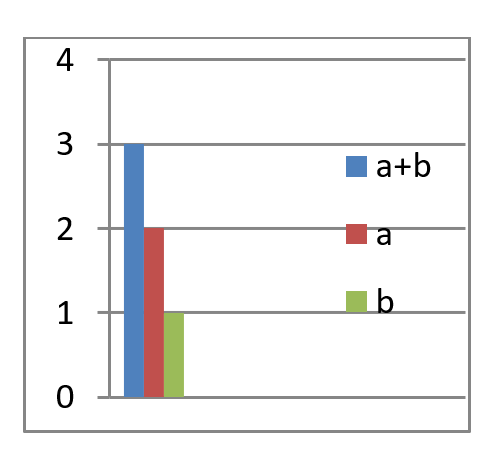
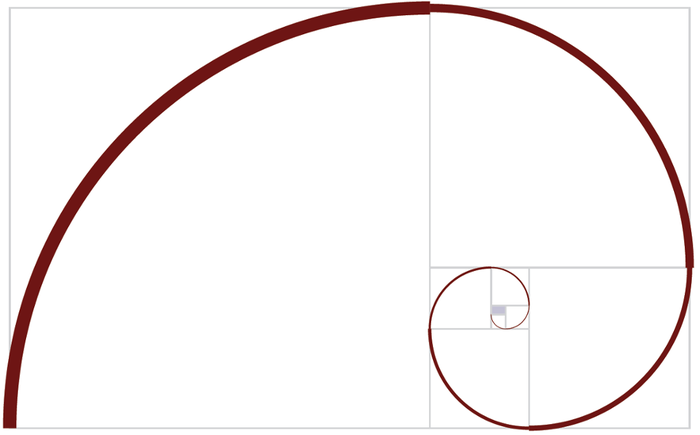
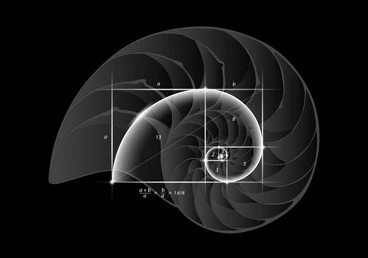
Sesquialteramusic is a virtual space of musical pedagogy created by Jorge Cova to share his music activities, outputs and mostly his goal of merging the historical-musicological approach to performance practice in music. The latter statement is enciphered in the site name: Sesquialtera plus music. As a matter of fact, Sesquialtera is the most perfect proportion within the Pythagorean numerical doctrine where it embodies the harmonic faculty widely spread in nature. Its perfection springs forth from the fact that the numerator exceeds the denominator by one half of the latter’s total number (superpartiente 2: m = n+1/n = 3/2). Quantities in that proportion keep a particular relationship known as the Golden Ratio (phi M) (where a>b: a+b is to a as a is to b, or a+b/a = a/b = phi, wherein the value of phi is: 1.6180339887…) (see chart bellow)*. It is twice comprised within Pythagoras’ Divine Tetractis (12:9:8:6), a sort of ruler encoding the perfect proportions in nature.** Therein 12/8 = 3/2 and 9/6 = 3/2. When applied to the octave, this proportion splits it into a lower fifth and its reversal, an upper fourth, the two most perfect intervals apart from the octave itself, according to Pythagoras and Medieval Music theorists. Throughout the Middle Ages, this proportion was the hallmark of beauty and perfection for all human creative outputs, including music composition. In keeping with its inner quality, artists saw to it that it visibly appeared in their creations. It constituted, therefore, one of the basic elements of the period’s esthetics. Notwithstanding, it remained, as we see it today, a philosophical approach to arts which did not married with practical arts considered, in early times, a mere craftsmanship. Hence, Sesquialteramusic makes allusion to the historical-musicological approach to music applied and merged to performance practice with the goal of yielding an interpretation liable to be considered truly historical.
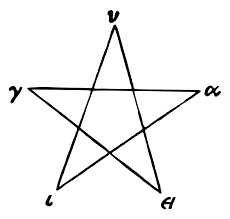
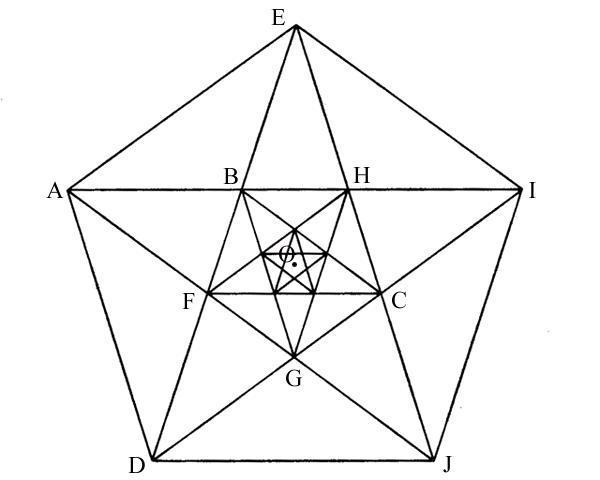
* Sesquialtera abstract proportion, seen as mathematical perfection, is materialized in the geometric shape of the pentacle (or pentagram), which was widely used by Pythagoreans to recognize themselves as brethren. This geometric shape was thought by the ancients as endowed with magic properties and related to the eternal. As a matter of fact, it is outlined by a pentagon when drawing a line binding the five pics. Moreover, the intersection of the five lines between the pics yield a pentagon in its center; yet a new pentagram can be inscribed in its center; and so forth in a Droste effect.
**Tetractis comprise two Genres, namely, the Multiplex Genre, 12/6 (=2), and the Superpartiente Genre. The latter comprise, in turn, two Faculties, namely, Harmonic Faculty (Sesquialtera Proportion), 12/8 and 9/6 (2+1/2 = 3/2), and Arithmetic Faculty (Sesquiterza Proportion), 12/9 and 8/6 (3+1/3 = 4/3). For the remainder possible combination within Tetractis the Sesquiottava Proportion, (8+1/8 = 9/8), which in music represents the interval of a second, was considered among consonances by the Pythagoreans as well as Medieval theorists (see Guido d’Arezzo’s Micrologus). Contrariwise, proportions within the genre Superparticulare (not included in Tetractis) where not considered “good”. Among them the third and its inversion, the sixth, which were, in fact, dissonant and, hence, banned from music. It was well after the mid 15th century, when European composers like Dufay and Binchois started applying Dunstable’s compositional approach of “pan-consonance”, that these “dissonant” intervals, now perfected as we know them today, began to be generally used in vocal music; and after mid 16th century Zarlino’s figuring out of the “Diatonico Sintono” temper, that they became usual in instrumental music for pre-set tunned instruments, namely keyboard and fretted.
Click on the thumbnails to open

 sesquialteramusic